
Isaac Allin is a full-time firefighter, a working arborist and a SPRAT-certified rope access technician as well as being a husband and hands-on father to 6 in Ontario, Canada.
In part one of our three-part chat, Sherie asks how he ended up wearing all three hats and how he does it all without burning out or losing love for the jobs.

Sherie: Hi Isaac, Let's start at the beginning. Can you describe your journey into your current career?
Isaac: The whole journey actually starts in high school. I more or less dropped out and joined the military. Through the military I did finish high school and got everything I needed, and I spent about six years in armoured reconnaissance. I really enjoyed that time.
Then I met my now wife, and things shifted. I didn't know if I wanted to be moving all over the place, getting transferred between provinces and time zones. I had to find something else, so I went to college, originally for fish and wildlife. I wanted to be a conservation officer, on the law enforcement side of things.
Whilst in college I joined the logger sports team, and that was really my first exposure to arboriculture. A lot of the people on the team were in the arb and urban forestry programmes, and it sounded a whole lot more fun than what I was doing. So I transferred into the arboriculture and urban forestry programmes at Fleming College, completed both certificates and kept competing in logger sports.
When I finished at Fleming, I went right into the arborist industry. I worked for a number of different companies, large corporations and small companies, and got exposed to different things in that world.

Sherie: Wow, so it wasn't really planned as such but we do love happy accidents – how did you manage to find yourself in a firefighting role on top of everything else you do?
Isaac: In 2013 my wife and I moved close to where we live now, because she got a job. She's a full-time paramedic and has been for probably 16 years, if not more. Through her, I got my first exposure to the emergency service world.
I had no interest. I had no desire. I did not see myself becoming a firefighter. But I really respected and appreciated the work she was doing.
Then COVID hit. and I met Jason from Maple Leaf Ropes for the first time and he said, "Hey, you should just come work for us." He kept saying that for probably a year or two.
At the same time the volunteer fire department was hiring, and my wife said, "Hey, you should apply." I said, "Okay, I'll give it a shot." The first year I didn't get on. The next year I did, and went through recruitment.
So both things happened at about the same time. I got on the volunteer fire department in 2020 and started at Maple Leaf Ropes in 2021. Leaving the city, I also went back to contract climbing, contracting myself out to a number of companies.
Getting on the volunteer department exposed me to the emergency world a bit more. In some ways it closed the loop and showed me some of the things I'd missed from the military: that brotherhood, giving back and making a difference. I thought, this is actually really, really fun.
In 2022 I started applying to career departments, and in 2023 I got on full-time with Six Nations Fire and Emergency Services. I've been there since October 2023.
Amongst all this, I got my SPRAT certification and got into the rope access world. So it was these three things all happening at once, and I really enjoy the nature of the work.
I don't think I could completely give up arb or rope access, and I definitely wouldn't give up full-time firefighting now. Each of them is distinct, but they do blend together, and there's a bit of overlap between the industries.
There are a lot of career firefighters I call part-time arborists and a lot of full-time arborists who are volunteer firefighters. I don't know if it's global, but here in Canada especially there's something about the arb industry that's tied to firefighting. I don't even know how to explain it, but there's something really cool there.

Sherie: I love how that's grown organically. You're obviously really passionate about this work. Is that something ingrained in you, or did it come from seeing your wife do it?
Isaac: It's interesting. She thought she wanted to be a firefighter, and then in high school she met a paramedic and said, "No, I'll be a paramedic." We make fun of each other all the time.
In the States a lot of the public EMS services are amalgamated with the fire service. I don't know how it works in Australia, but in Canada they're two different branches. There's the Coast Guard and others too, but the big three are police, fire and EMS, and you like to banter.
So she joked that I should join the volunteer fire department, and when I got on, the banter went back and forth. I call her a bus driver because she just drives people around. She calls me a hose monkey. She says, "You guys just put wet stuff on hot stuff, right?" I think that's healthy.
I don't know if the passion for the emergency service came from her or from somewhere else. If I look back, I can see that when I left the military I lost part of myself and didn't really know what I was doing. I loved arb, but joining the fire service gave me that brotherhood again, and the same joking back and forth. You need a pretty dark sense of humour to survive in the emergency world. It was like putting back a lot of pieces I didn't realise were missing from the military.
I also just have a passion for people. My wife always jokes that I've never met a stranger, because I can talk to anybody about anything. I take that as a compliment. I think that's what I enjoy about still being in all three industries.
I spoke at the ISA Ontario conference last year with a good friend of mine, Luke Pedis. He's a full-time firefighter who also owns a tree company. We spoke specifically on first aid in the arborist industry. Afterwards people are asking questions, and I get excited because other people are getting excited about it. That's shifting the mentality, having those conversations.
Through the fire service I'm helping people in their worst situation, or we're going to a school and interacting with kids, or to a community event. You feel like you are making a difference and making a change. In the arb world it's the same thing. There's something really cool and colourful about it, and I get to bring the rope access and rescue side into it too.
In rope access, more or less, I just do rope work. I get to go to different places and climb really cool stuff. But of the three it's probably my least favourite, because you're not having those same interactions. It's not as organic. It's a little more transactional.

Isaac: Being on full-time fire, doing my SPRAT and being an arborist, the rope access, tech rescue and rope rescue all blended into arb. That's where I started to see the holes and the need for more first aid, aerial rescue and practical knowledge on that side of the arb industry.
In the fire world we only ever see it when things go wrong. People are calling us on their worst day. And when we show up, it could have been prevented in so many different ways.
In the arb world you do a job plan and you do your annual training, but there are a lot of gaps and misconceptions, partly because of the nature of the industry. A lot of crews here are two or three people. That immediately raises the risk, because you have fewer people to deal with it if something happens. You're also running a saw and working at heights. So many hazards from other industries are all combined in the arb world.
So I did a bit of a pivot and pinpointed the rescue part of the arb industry, trying to shift a mentality and shift a culture. Simply telling people they're not doing it properly, or how they should be doing it, doesn't work. People aren't receptive to that. The goal is to shift the mentality so they're aware of the fact that they need it.
In some ways that's how the conversation started with Dan. The ironic part is I've never actually met Dan in person, but we've been talking for years. We've sent stuff back and forth, and I've talked with him for hours on video chat, on phone calls and in messages on Instagram.
It started when I was at Maple Leaf Ropes, where we were selling his products. We'd chat about the Reecoil products and what we should bring in. Then it developed into quality conversations, like this one, about the state of the industry, how to shift the mentality and how to make it safer for everybody.
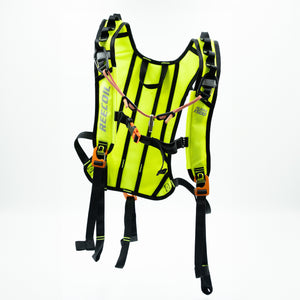
That's when he first showed me the Deploy, near the early inception of its design. He sent me multiple prototypes to try and give feedback on.
So it started as a transactional relationship, and very quickly it shifted. We were building an actual friendship and trying to promote the ideology he has behind Reecoil the brand, not just selling the product. It's been really organic. The fact that I have that deep a relationship with someone on the other side of the world, 14 hours ahead, having never met him in person, is pretty cool.
Sherie: That's so cool. We're honoured to have that relationship with you.
Stay tuned for part two: how Isaac handles the heavy days, and why community matters.